Showcasing UTC in 180 seconds
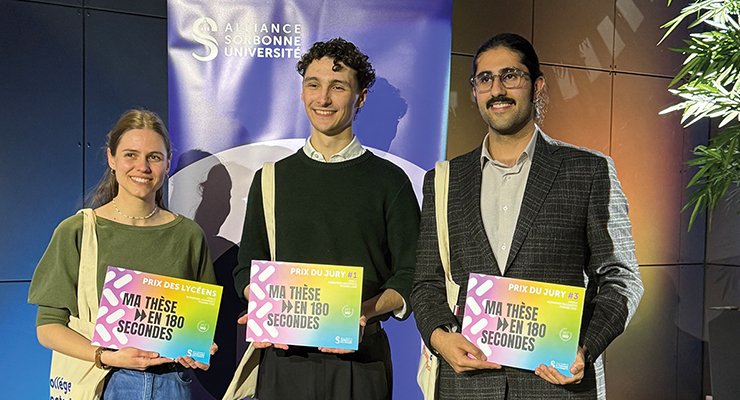
Bastien Lahetjuzan, Sorosh Samiei and Marie Crémillieu won awards at the Alliance Sorbonne Université finals of the 2026 edition of the “My Thesis in 180 Seconds” (MT180) competition. Another way to discover the full richness of doctoral research at UTC.
Three UTC doctoral students distinguished themselves at the Alliance Sorbonne Université finals of the “My Thesis in 180 Seconds” competition, winning three awards in different categories. Bastien Lahetjuzan received the First Prize from the jury, earning him first place. Sorosh Samiei received the Third Prize from the jury, and Marie Crémillieu won the High School Students’ Prize. The MT180 competition is an exercise in science communication in which doctoral students present their research topic in exactly 3 minutes. It is a major challenge that requires scientific rigour, teaching skills and the ability to explain complex concepts in layman’s terms. This year, the Alliance Sorbonne Université finals featured a wide variety of topics, ranging from philosophy to chemistry, including linguistics, neuroscience, and biology. “It provides a way to make research accessible to the general public, so you have to summarize what you’re doing in three minutes — 180 seconds. It really has to be accessible to a general audience—you have to explain the issue, but without getting too bogged down in details, using words that everyone can understand. I think this is a truly interesting exercise for doctoral students. It forces them to take a step back from their topic, put themselves in the listeners’ shoes, and try to explain what their work is all about,” emphasizes Christine Prelle, director of the doctoral school.
Promoting the dissemination of knowledge to the general public
Marie Crémillieu enrolled at UTC in the general studies programme after earning a science-focused high school diploma, before continuing on to the elective specialty Process Engineering programme. She also completed a Master’s degree in Formulated Products Engineering before beginning her dissertation at the UTC-TIMR laboratory. She hopes to pursue a career as a researcher in industry, while maintaining a focus on education and science outreach in her work. Between organizing “Pint of Science”, a local edition of the world’s largest science festival, a conference and her thesis work, she looks back with us on her MT180 adventure. “I’m very passionate about science outreach to the general public. I had already participated in the Nuits de la Recherche and the Fête de la Science, where I was able to present my research to UTC students, schoolchildren of all ages, as well as residents and families in Compiègne. Participating in the MT180 competition was therefore a natural extension of this approach: bringing science out of the laboratories and making it accessible to as many people as possible, beyond the local level.” After passing the initial selection round, she competed in the Sorbonne University Alliance’s local final on March 19. The High School Students’ Prize she received allowed her to compete in the Paris regional final, which took place on April 9.
Training Sessions and Stage Presence
The Sorbonne Université Doctoral College prepared the candidates through several training sessions with a coach specializing in public speaking, who has been working with them for several years. But the preparation didn’t stop there: the advice and discussions with the other participants were very stimulating as they worked on their angles of presentation. “Until the first final, I practiced mostly on my own, then in front of my thesis advisor. I wanted to keep it a surprise for my family, friends, and colleagues who came to watch the Sorbonne University final so they could see my presentation live on stage. Then, for the regional final, most of the work was done, but there were still details to fine-tune: certain words, pauses, body language… Right up until the night before, I was still improving my script! We also had to adapt our stage presence to the technical conditions.” Her topic? 3D printing of stimulable functionalized biomaterials. “I was particularly drawn to this thesis topic because of its multidisciplinary nature. It draws on expertise in formulation and chemistry to develop the gel I’m printing, in processes and mechanics to optimize 3D printing — an innovative technology — as well as in biology for the ultimate biomedical application of my biomaterial.”
“I was struck by the richness and diversity of the research”
For Sorosh Samiei, a doctoral student in bioprocess engineering, it all began during his capstone internship at L’Oréal, where he participated in an internal version of the competition titled “My Project in 180 Seconds,” presenting his internship project to the company’s advanced research community. “The exercise turned out to be much more rewarding than I had anticipated. It allowed me to build some valuable connections and to appreciate the power of science communication for the general public. That’s when I decided that, as soon as I started my PhD, I would embark on the real adventure.” Sorosh made it a point to practice every evening at the office, once his colleagues had left, rehearsing with a stopwatch, identifying passages that lost momentum, choosing where to insert pauses, and refining every word. This meticulous practice gave him, on the big day, a precious freedom: the freedom to be fully present for the audience rather than absorbed in his own notes. “The two finals—the one at the Sorbonne University Alliance, followed by the one for the Paris region, were memorable experiences. As I discovered the other candidates’ projects at the same time as the audience, I was struck by the richness and diversity of the research being conducted today. The stress, however, was very real. But once on stage, everything picks up speed in the best possible way. A brief interaction with the host creates an initial connection even before the 180 seconds begin. Then time flies by at a dizzying pace. What I was looking for above all else was a connection with the audience: having them for three minutes is both a short and a long time. Both times, I had the satisfaction of seeing their eyes locked on to me, hearing laughter at just the right moments and receiving applause that was worth more than any award.”
Talking About biogas and sustainable aviation fuel
Sorosh Samiei works on anaerobic digestion, the process that converts biowaste into biogas. His thesis is part of a European project (Interreg OBIWAN) that takes this ambition even further: converting this biogas into sustainable aviation fuel. To achieve this, biogas production must be stable, both in terms of flow rate and composition. However, the feedstock entering the process is subject to significant seasonal and regional variations. His work specifically focuses on managing these irregularities by combining numerical modelling, experimentation and control systems. “I began my studies in pharmacy at the University of Medical Sciences in Tehran, before going on to earn a bachelor’s degree in life sciences at the University of Lorraine, followed by a Master’s degree in Biomedical Engineering and Bioproduction at the University of Montpellier. I am currently in my first year of PhD studies at UTC, at the intersection of biology and process engineering. I am deeply passionate about research and development — not as an end in itself, but as a catalyst for transformation. I am convinced that scientific work is only truly accomplished when it leaves the laboratory to generate products that improve daily life and create value in the real economy. It is in this space, between innovation and its implementation, that I want to forge my path.” n KD
3 000 PhDs have graduated from the UTC doctoral school since 1985
The University of Technology of Compiègne has devoted a significant portion of its activities to training in and through research—that is, to the doctoral programme. As early as 1985, when the state doctorate was abolished and the unified doctorate was created, UTC established its own doctoral school, even though there was not yet a standardized framework at the national level. “Based on an idea by Dominique Barthez, a professor at UTC, the creation of this structure aimed to define a comprehensive postgraduate training policy and to foster collaboration among UTC’s various research teams on its technological research agenda, which is inherently multidisciplinary. The purpose of this doctoral school was to manage student recruitment and monitoring, harmonize course programmes across UTC’s various specializations UTC, and to offer shared cross-disciplinary courses to provide students with a solid scientific foundation,” explains Christine Prelle, director of the UTC doctoral school. Since 1985, the doctoral school has awarded PhD degrees to approximately 3 000 doctoral graduates. Today, it supports multidisciplinary—and even interdisciplinary—technological research more than ever, recruiting doctoral candidates from 11 research laboratories. All are funded for at least three years and can pursue their doctorates in various settings.
KD