Product optimization and upcycling: the API’s guiding principle
Through its winter and summer Inter-semester Educational Activities (API), the University of Technology of Compiègne, in partnership with the Sorbonne University cluster, offers UTC students and international students from partner universities the opportunity to engage in original and innovative programmes that complement their academic curricula. Examples include the “Happy Sound” workshop held from January 19 to 23 and the International Winter School on Food Engineering, which ran two weeks, February 2–13, 2026.
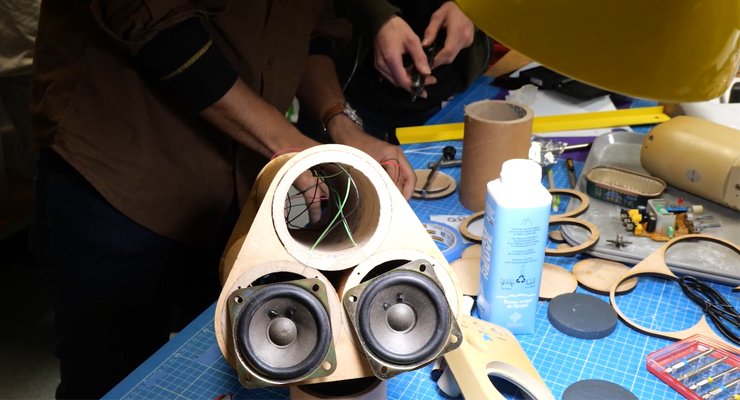
Innovating in teaching methods, deepening and acquiring skills and knowledge in specific fields or technologies: the Intersemester Educational Activities (API) offer numerous benefits to the students who participate. Combining theory and practice, these international winter (and summer) schools, taught in English, “enable students to critically examine current practices and supplement their learning,” says Nicolas Dauchez, a professor at UTC and researcher with the Acoustics and Vibrations team at the university’s Roberval Laboratory. The ‘Happy Sound’ workshop on “upcycling portable speakers,” which he led from January 19 to 23, 2026 as part of the Erasmus+ SUSEE (Smaller Universities for Sustainability in Engineering Education), invited about fifteen students from the acoustics and design programmes to “modernize and design speakers using used and obsolete desktop speakers as part of an approach to sustainable engineering and the repurposing of technological products — an approach that is now an integral part of our curriculum.” For students in the acoustics programme, working on speakers was very interesting as it allowed them to understand the entire process — from design to manufacturing — and to take an existing concept and learn how to use it in a new way. ”Since the launch of the ‘Happy Sound’ API in 2018, the challenges have multiplied: building speakers without using wood, and conversely, wooden speakers in collaboration with the Saint-Quentin School of Applied Arts; designing and manufacturing speakers made of cellulose-based materials or tubes; designing subwoofer enclosures… It fosters healthy competition. We’re often pleasantly surprised by the resulting concept or design. In 2020, focusing on the sound of wood, we achieved some pretty amazing results—clean and very ‘polished’. The ultimate goal, within a relatively short timeframe, is to ensure everything works and to conduct comparative listening tests to evaluate the acoustic quality. “Every year, we set new performance, technical, and budgetary constraints,” continues Nicolas Dauchez. “This winter, the question arose regarding the portable drum set, which requires resources: Is the portable battery sustainable and long-lasting? Do we really need it? A visit to the Paprec factory, which specializes in recycling and waste treatment, helped us realize the consequences of consumption and the problematic future of batteries.”
Gastronomy, a holistic science
The same objectives were set for the 3rd edition of the Food Engineering International Winter School, which took place at UTC’s Daniel-Thomas Innovation Centre from February 2 to 13, 2026 “We offered projects combining food science and technology with French gastronomy,” explains Mirian Kubo, a faculty researcher and head of the Food and Agro-Resources Innovation (IAA) programme at UTC. The 16 students—about half of whom were enrolled in the Master’s programme in Nutrition, Quality and Health at Sorbonne University, with the other half from European universities in the SUNRISE Alliance, were tasked with developing innovative technological solutions to create healthier and more nutritious versions of world-famous culinary specialties such as beef Bourguignon, foie gras, tarte tropézienne, and gougères.”
Over the course of ten days, which included theoretical classes, practical work and project workshops, the students developed food prototypes complete with specifications, nutritional value tables, ingredient lists, sensory profiles, label designs, and packaging proposals… “They study the nutritional profiles and functional properties of ingredients, texturizing agents, the impact of additives and flavourings… But also the latest innovations for replacing fats, sugar, and gluten,” explains Mirian Kubo. “We aim to improve the nutritional quality of products by enriching them with protein and fibre. But we also seek to meet the needs of people with allergies, diabetics, or those with intolerances—such as those with celiac disease. We’re also addressing the needs of seniors and children, who require tailored nutrition as well.” In 2025, gluten-free gougères and vegan beef bourguignon were on the menu. The new products had to taste pleasant and similar, with the same texture and flavour… “These workshops always offer opportunities to learn, especially since international students bring cultural adaptations to the table,” adds the expert. “Last year, gnocchi made from stale bread were served with a traditional Portuguese sauce. It was a real culinary discovery.” The cooking workshop led by Ludovic Colpart, chef at the Auberge du Pont de Rethondes near Compiègne, the cultural tour of Pierrefonds and dinner at a gourmet restaurant, in addition, allowed students to expand and enrich their skills and techniques, as well as refine their knowledge. They experienced some true discoveries.
IL