Take on the challenges of your time
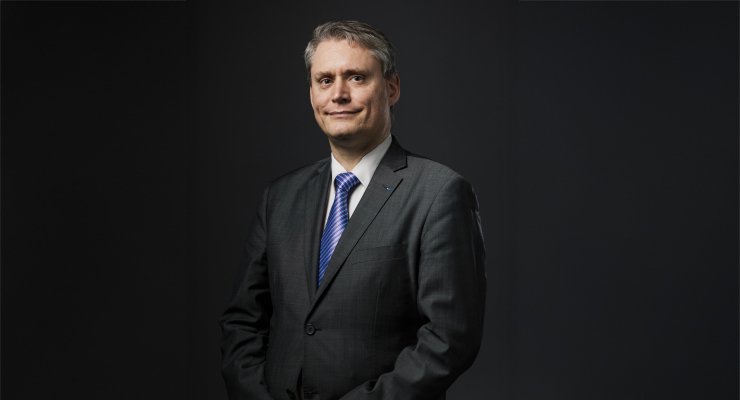
A engineering graduate from the École Polytechnique appointed to the Corps des Mines, Stéphane Dupré la Tour is the Director for Advanced Innovation and Digital Technologies at EDF. He is the Godfather of the 2025 graduation class.
After completing his engineering studies, Stéphane Dupré la Tour was assigned to the Lille regional prefecture as a civil servant. What were his duties? “At the time, numerous industrial sectors, particularly steel, textiles and mining, were undergoing restructuring or even disappearing in the Nord-Pas-de-Calais, as the region was then known. The job involved managing industrial conversion projects and economic aid”, he says.
After this initial experience, he joined the decentralised Government services for the Environment. “Regional conversion had to do with complying with regulations concerning soil, air and water pollution, among other things. We therefore implemented the first regional plan for industrial waste management and air quality’”, he explains.
One situation, in particular, made a lasting impression on him: seeing children living near a former steelworks with concentrations of metals in their blood so high that they suffered from severe cognitive disorders. This is what made him aware of the links between the environment and health. Faced with the reality of the ‘North’, Stéphane Dupré la Tour has always tried to find solutions to improve the environment without leading local industries to close down.
After a short period at the Ministry for Industry, he joined the cabinet of Jacques Chirac in year 2000, then President of the Republic, as an advisor on ecological issues “It was when I took up the post that I realised the scope was much broader, as it included, among other things, transport, industry and crafts, innovation, land use planning, etc. In short, anything that could have an ecological impact,’ explains Stéphane Dupré la Tour.
During the 2002 presidential campaign, candidate Jacques Chirac — who showed a genuine interest in environmental issues — made a flagship proposal: an Environmental Charter. When Jacques Chirac was re-elected, Stéphane continued to serve in his cabinet, set to work and the Environmental Charter, a text with full constitutional value, like the 1789 Declaration of the Rights of Man and of the Citizen, was promulgated in 2005. It includes the right of everyone to live in an environment that does not harm their health.
“Throughout the five-year term, we started with the environmental facts and rolled out a comprehensive programme for sustainable development, including a national health and environment plan. My lessons from the “North” had borne fruit”, he explains.
“In a complex and sometimes anxiety-provoking world, it is essential not to give up. Each generation faces major challenges and must put all its energy into meeting the challenges of its time. At the UTC Open Days, I realised that the UTC’s educational project — which fully incorporates humanities, can equip its students to do just that,” concludes Stéphane Dupré la Tour.
MSD