Quatrium Hauts-de-France, a new technology platform dedicated to the industry of the future
The launching of the Quatrium Hauts-de-France platform at UTC, on November 14, brought together nearly eighty people. All came to discover the technologies and expertise available to support industrial SMEs and mid-sized companies in their digital and ecological transformation, as well as concrete solutions to gain agility, performance, and resource efficiency.
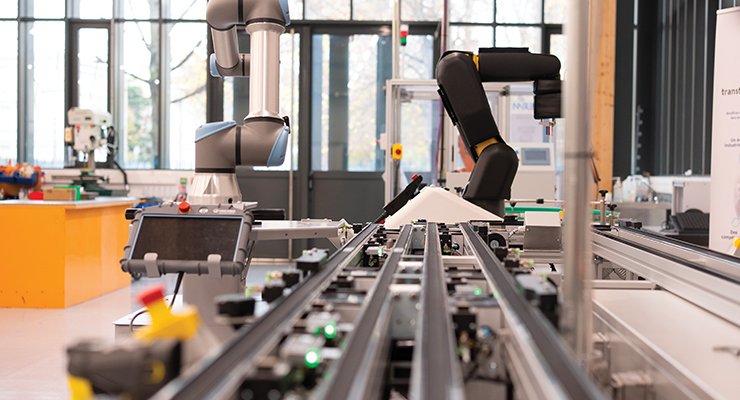
The Quatrium project was submitted by CETIM to BPI France in response to the 2020 “Industry of the Future Acceleration Platform” in 2020. It received the Prime Minister’s approval in 2021. Quatrium is a national project implemented across four regions: Auvergne-Rhône-Alpes, Grand Est, Hauts-de-France and Pays de la Loire. CETIM welcomed the first companies to its platforms in 2022. UTC-Compiegne joined Quatrium Hauts-de-France in early 2025 thanks to funding from the Region and the European Union. The project aims to provide companies with support from specialists to ensure the success of their modernization projects. Customized pathways are offered for each company. From technical advice to implementation support, UTC provides solutions that complement those of other partners. A dedicated space at UTC allows new technologies to be presented to local manufacturers. While CETIM naturally focuses on the mechanical engineering sector, UTC complements this approach by engaging companies in the chemical and agro-industrial sectors. The idea? It involves developing connected tools for manufacturing processes, such as a smart conveyor line. The goal of the Quatrium Hauts-de-France platform is to accelerate the digital transformation and the ecological and energy transition of SMEs and mid-sized companies through tailored support for each business.
Test, integrate and take action
Thanks to demonstration platforms, companies can test and identify technologies suited to their needs. At UTC-Compiegne, the technical facility provides state-of-the-art equipment for the industry of the future, including a smart, connected conveyor line. “UTC teams and experts will advise companies based on their projects: solution selection, sustainable integration, testing, ensuring the reliability of investments, industrialization and staff training,” explains Muriel Windholtz, Head of Operations and Corporate Relations for the Quatrium Hauts-de ‑France project at UTC-Compiegne. Quatrium aims to answer questions that industrial SMEs are asking themselves. How can they take advantage of the projected digital transition in their factories? How can they gain flexibility and agility? Or, how can they integrate the circular economy while remaining competitive?”
At the heart of UTC’s DNA
The proposal is to help participants discover the benefits of new technologies in the factory place through seminars and workshops, to see these technologies in action and to take the next steps by implementing them. For Julien Le Duigou, a professor of Mechanical Engineering at UTC’s Roberval Laboratory and head of the integrated production and logistics programme within Quatrium Hauts-de-France at UTC-Compiegne, this platform is fully aligned with UTC’s strategy as it combines teaching, research, and industry partnerships—which constitute the very DNA of UTC. “The goal of the Quatrium Hauts-de-France project is to help the Region’s Small and Medium-sized companies (SMEs) achieve their digital and environmental transition. The benefits for students are that they can work on technologies they will encounter later in the workplace. The benefits for faculty members will be having the opportunity to work directly with companies on real-world problems using real data. And for the companies involved, it’s also about building connections—both with students to ensure they have people trained in their technologies, and with faculty members who can provide expertise on the issues that concern them.”
Synergy of trust and experimentation
Within Quatrium Hauts-de-France, companies will therefore submit their challenges, their products, and their data and faculty members will be in a position to contribute their expertise and insights from their research, working alongside the companies to develop innovative solutions. “The next phase of the Quatrium Hauts-de-France project at the UTC will involve continuing to develop the platform with new scenarios and new technologies that we’ll be able to integrate,” adds Julien Le Duigou. “The goal is to position Quatrium as a hub so that companies in the Region automatically think to go through Quatrium when they want to identify or even develop new technologies in their factories.” All of this is aimed at strengthening French industry, which is suffering from a competitiveness gap due in part to aging machinery and facilities. The industrial landscape in France 80% SMEs, which, with Quatrium, will now have a decision-making tool to move forward and secure their projects.
The connected factory at the heart of the coming industry of the future
The global “Industry 4.0” market is booming, with an estimated average annual growth rate of 16.4% over the 2021–2028 period, ultimately reaching $337.1 billion by 2028. The impact of the health crisis has forced many companies to reinvent themselves, for example: through the digitization of processes. “Industry 4.0” today rests on three main pillars: industrial controllers (approximately 20% of the market), connected factories (approximately 40% of the market) and industrial IoT [internet of things)(also approximately 40% of the market). The connected workshop involves the connectivity of manufacturing machines, as well as their networking and the overall communication of a set of tools comprising a process. With Quatrium, CETIM and its partners, such as UTC-Compiegne, provide companies with experts in transformation and available technologies, along with personalized support.
Seven major challenges for industrialists that can be actively addressed via Quatrium
- Manufacturers will receive guidance in developing their decarbonization strategies.
- Quatrium experts offer support to conduct an energy audit, establish management systems and recover, optimize, and/or reduce energy consumption.
- SMEs can receive advice on reducing noise, soil pollution, and smoke emissions.
- Quatrium experts will guide companies in the eco-design of their products, digital modelling and simulation, the qualification of new production technologies, the industrialization of a new product and developing a roadmap for moving upmarket.
- Manufacturers can benefit from the performance and agility offered by new technologies, receive guidance on process automation or robotization, and achieve digital continuity.
- SMEs will receive guidance on managing production flows and organization and optimizing process performance.
- Quatrium’s support enables the development of connected products, artificial intelligence and automated product inspection…
KD