Artistic creation, research and engineering sciences: the reasons to get together
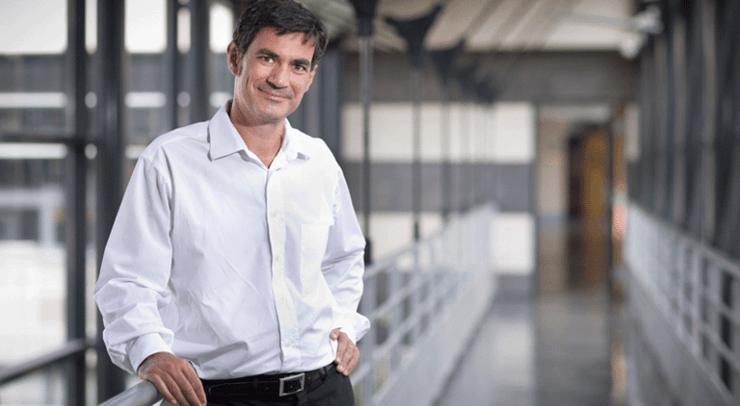
As Serge Bouchardon, Director of the UTC-COSTECH Laboratory, Professor in ICT, sees it, the artists and scientists have lots of points in common. Witness the shared approach in research and creation that aims at emancipating actors from raw, direct observation of reality to better seize its deep nature. This specialist in digital writing is also an author in the field of digital literature. He explains why science and art would find it advantageous to work together.
What links do you see between artistic creation and engineering sciences?
Both artists and engineers must have an in-depth knowledge of their ‘supports’ and tools (digital tools, for example) they use in their work. Their shared adventure is how they control and use their tools and on how they contribute to ‘lending meaning’ to their work, and new dimensions opened by (or avoided by) technology and its progress which is a reflection that is very important in digital operations which is the basis of today’s technological milieu. One form of collaboration consists of welcoming artists into our academic laboratories. Experiments were conducted as of the 1950s, then further developed in the 1960s and 70s. Nowadays, we see more frequent interactions and indeed real-life collaboration. The alchemy between artists and scientists is a fragile situation, where going beyond the specialty boundaries (leading to scientific, technological and aesthetic breakthroughs) presupposes that art is not serving science, nor the reverse. Artist-scientist collaboration often leads to rethinking the priorities, valorising the process rather than the results, but also throwing light on the role of prototypes as something common to artists, research scientists and engineers. This collaboration is exemplified in the stage work proposed by ALIS who explore non-verbal language uses. In 2015, an artistic residential agreement was signed with UTC, under the denomination research artists in residence, with the aim to underline how artists can be totally involved in the scientific research work. In symmetry, scientists can also be actors in artistic creation, as we can see in the project called La séparation.
But why do you get student-engineers involved in artistic projects?
The way you can learn creativity can come via various channels, among which a primer to artistic creative practices. Engineers, above all other considerations, build uses but can also be inspired by artistic works that, in essence, reroute and rethink the uses and invent new possible worlds and ways. Some features here can be seen as shared by artists and engineers. When an engineer designs objects, he/she is in fact doing a DIY mix of heterogeneous ingredients (they can be scientific, social, economic …). Such handicraft is akin to the work done by artists when seeking their ingredients for a piece of art-work. For several years now, I have had student-engineers get involved in digital artistic creations, and also had them work with the artists themselves. In this approach they have a better sense of the interdependence of technical and cultural aspects in the digital world.
What is the contribution and ‘creative’ role in your research?
UTC often emphasizes research-design approaches, where the basic hypothesis is that research can not only help us understand and implement but also to implement and understand. This idea come hand-in-hand with research creation which allows you to create and understand. This novel approach is encouraged at UTC by the Research Directorate and also by the UTC Daniel Thomas Innovation Centre who wish to take advantage of (and build on) the students’ artistic potential. It is my privilege and pleasure at IUTC to embody this research-creative approach, among others. As a research scientist, my work focuses on digital writing (multi-media, interactive, collaborative projects), especially in the field of e‑literature, where I am interested by staging interactivities and the role of gestures in interactive writing. A research-creation approach is an invitation to design and assemble experimental set-ups (objects …) which allow me to verify certain hypotheses and certain concepts. Creation allows you, in effect, you create the conditions needed to ensure observability of phenomena and their occurrences. Research-creation can prove attractive for the designing of objects/practices that relate to the digital world. The latter are still being perfected and the creative approach offers opportunities to ‘think differently” and to perceive as yet unknown levels of meaning.