3 questions to Prof. Claire Rossi, director, president and vice-chancellor UTC, one of a member universities of the SUNRISE Alliance, itself one of the most recent european university alliances
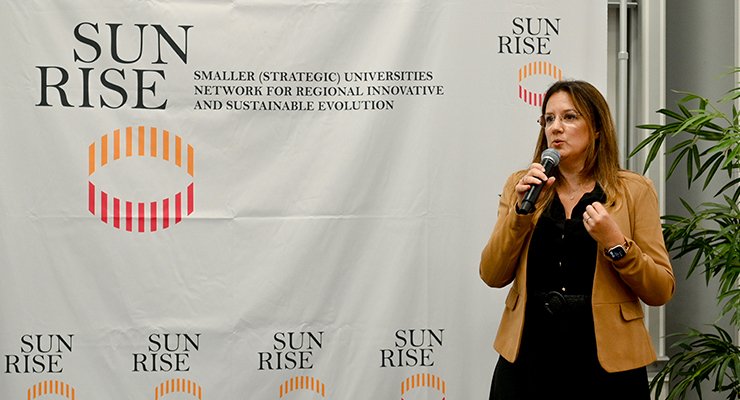
Who was behind the Sunrise initiative?
“The initiative to create the SUNRISE European university alliance came from the rector of the Technische Universität (TU) Ilmenau (Germany), who proposed to his trusted partners that they join a consortium being set up as part of the European Union’s latest call for proposals on European university alliances. UTC-Compiegne was already working closely with TU Ilmenau and the Libera Università di Bolzano (Italy) through the Erasmus+ SUSEE (Sustainable Student Entrepreneurship) project, which focuses on sustainable entrepreneurship and student innovation. This strong cooperation naturally led to a convergence of visions around a structuring alliance. As soon as I had taken up my position as Director of UTC, at the end of 2022, Joanna Daaboul, UTC’s Director of International Relations, and I seized this opportunity to work with TU Ilmenau and other partners to develop a joint proposal. Despite a very tight schedule – the call for projects closed in 2023 – we have actively contributed to defining the alliance’s strategic orientations. UTC has brought its own specific vision to the table: that of a medium-sized university of technology, strongly rooted in its territory, focused on responsible innovation, technology transfer and support for ecological, digital and societal transitions”.
Would you say that this summit was a success?
“Absolutely “yes”. First of all, there is an incredible atmosphere and I find that in the few months since the alliance was formed, very strong bonds have been forged and friendships have emerged between people… There is a real closeness between the people involved, which is the key to the success of alliances. If people only get together to work without any human interaction, the situation will not last. The positive energy in the amphitheatre during those three days was incredible. This was noted by the authorities present, including the Director General for Higher Education and Professional Integration, the Vice-Chancellor for Higher Education and Research, the Director of Erasmus+, the Director General of Campus France alongside representatives of the city of Compiegne and the Hauts-de-France Region”.
What actions or objectives were defined at the summit?
In a very short time, we produced a detailed map of regional training and professional skill needs, presented at the alliance summit. This exercise responds to one of SUNRISE’s major ambitions: to design joint and innovative training programmes in order to respond more effectively to the specific economic, social and industrial specificities of each territory where our universities are located, while identifying gaps and as yet unsatisfied needs. This approach forms the basis of SUNRISE’s networking activities. The aim is to use this shared analysis to develop joint programmes based on the pooling of our institutions’ expertise and resources, in order to provide concrete, tailored and sustainable responses to the development challenges facing European territories.
MSD