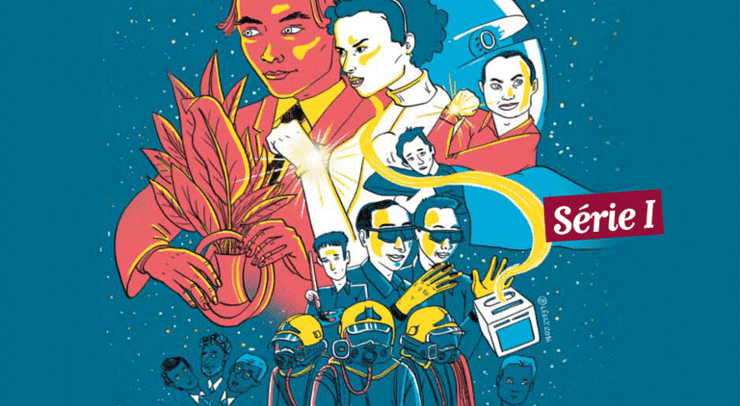
37: UTC Startups — Series I
All vertical market segments are affected by digital innovations and by trends seen at the Consumer Electronics Show (CES), undoubtedly the greatest hi-tech event in the world, which 3 UTC start-ups chose to attend.
Consider the distribution sector which is having to think hard about on-line trade (e‑commerce) and virtual reality. Insurance companies are concerned by the development of driverless cars. Banks are closely monitoring mobile phone transactions. Automobiles are taking on board more and more technologies, for audio, sensors, assisted even automatic driving. Traditional sectors can see how their competitors are jumping on the connected object band wagon or not. In short, everyone is involved to a greater or lesser extent!
Visiting the CES provides the opportunity to analyse digital strategies with real-life ingredients, users and targeted uses, without forgetting or neglecting the underlying economics: is the price to pay for a connected solution worth it? Could the price possibly drop radically to democratize uses? This sort of question is valid everywhere: for 3D printing, for 4K TV and all sorts of connected objects to come. The 3 UTC start-ups had a continuous education boost at the CES2016, Las Vegas.
Major industries innovate by integrating what is technologically imaginable, mixing with the possibilities offered with what can lead to better client services and/or better company performance ratings. It now remains to balance outsourcing and in-house resources for the risks connected with innovation. In particular UTC fully approved when we heard Shawn DuBravac ‑chief economist and director of research for the Consumer Electronics Association (CEA) ®, a U.S. trade association – declaring loud and clear that it is not the technology that counts but rather the uses made of technologies. You have to focus on what is possible, from a technological point of view and also on what is meaningful. The name of the game is meaningful versus possible. The products presented by three UTC graduates present at Las Vegas and the other French start-ups detailed in the brochure underline this priority. To a large extent, they have taken on board the future trends in health, food and entertainment sectors.
However, it is clear today — as Professor Dubravac confirmed — two third of the business turn over in digital products is concentrated in only a few categories: mobile phones, i‑pads, television sets and computers. But the emergence of new categories such as drones, virtual reality or 3‑D printing could change the ‘givens’ here.
Over and beyond the products aspects, the 2016 CES has underscored three key mega-trends that help us foresee the coming major digital world changes:
• Ambient detection: we already have sensors that can measure everything continuously, monitor babies, drivers, house temperatures, physical activities, cats and dogs, what we eat and all of this is ‘filmable’ and ‘recordable’.
• Aggregate learning relates not only to making use of data from the sensors (light levels, weather, numbers of persons present, temperatures, level of fatigue), but also involves the Google learning algorithms also based on the data, IBM Watson …in a word, aggregate learning comes via collective learning and continuous system information to develop the best scenarios as seen in video games and with the equipment manufacturers who are now creating machine learning and auto-learning protocols.
• Building up ecosystems: it may seem self-evident, but new technologies tend to mature as and when their local ecosystems are established. A good example here is in VR (virtual reality) which will soon be used to promote travel spots. The ecosystem here will surely integrate the 360°’ full-circle’ cameras seen at the 2016 CES. And we also note that 4K TV is coming of age.

Aspic Technologies designs and proposes various software packages and equipment to video game and VR professionals, helping them to integrate a highly realistic sound surround environment. “Aspic Technologies makes the video and sound components coherent in a virtual environment, replacing long and costly alternative methods by a real-time, efficient solution, albeit with a few ‘approximations’”, explains Quentin George.
The startup company is notably sole supplier for software and sound equipment for the EQUIPEX Innovation-Research platform for the Digital and Interactive Visual Environments (IrDIVE) at the SCALab laboratory at the Universities of Lille. The new platform will be inaugurated officially in Spring 2016 and will become the largest VR facility in France.
Moreover, the company intends to launch a fund-raising campaign during the coming year, to enable the founders to complete their marketing and sales staff.

“Our objective is to design a medical device to prevent, treat and monitor posture-related problems and issues. The device requires use by a health sector professional (a medical practitioner, a kine-therapist, etc.
This particular project goes back to 2014 when Antony Rouhban and Nicolás Latorre registered for an “innovation competition” organized by the French Association for Bio-medical engineers (AFIB): “Nicolás had an excellent grounding in electronics and he added skills in project management, marketing and regulations. We then decided to present a project at the AFIP competition, with Didier Gamet (UTC-BMBI Lab) accepting that our presentation count as a TX (CC) credit course.
Antony and Nicolás came First ex-aequo in the competition results and were also ranked among the 20 first projects selected for the Pépite Prize, springboard for student entrepreneurship. Their project also received a pre-certification by the UTC-Innovation Centre during the Sept. 201 assessment session for innovative projects. “Pre-certification, hopefully followed by full certification this coming year, enabled us to raise some funding but more than that to acquire a necessary qualification to allow other UTC students to work with us on the project”, adds Antony.
The UTC- Daniel Thomas Innovation Centre provided a perfect setting for these two young entrepreneurs so they could continue to develop their project. “We used to the full the resources made available by UTC and the Innovation Centre”, Antony confirmed. Over a one year period “we worked with close on 50 UTC students in a varied set of skills, from project management, economic intelligence, design, enterprise creation … We notably ‘hired’ several students in the MPI major, which allowed us to have a precise monitoring of the various stages and this help was much appreciated insamuch as I was very busy in a placement during the previous semester. We made good use too of the Fab’Lab and the ‘motion capture room’ and equipment installed at the Innovation Centre.

We often imagine that art-work sales are reserved for an elite and very limited milieu, in the art galleries, or at auctions and think that the Web is not adapted to this market segment.
“I wanted to set up a Web-based project and I had noticed that the art market was way behind in term of digital issues. That was why I oriented my thinking to this area, more than through by any special art inclination” says Adrien Saix, a UTC graduate engineer who took the major GSU (Urban Engineering Systems). “And inasmuch as I myself did not a clue to art works and values, I was able to take a fresh and innocent look at the scene. Today, naturally, I have improved my art culture but the very fact of having a naïve standpoint when I began working on the project allowed us to create something really innovative given that we were not influenced at all by current art market practice”.
MyArtMakers, is a web-based site, similar both to a Market-place (like Amazon®) and to a social network (like Facebook®. Art lovers, collectors and artists can register on the site, but with two different procedures. It is free for the art fans and collectors, who are invited to ‘follow’ up to 40 artists and to ‘like’ about 100 pieces of art, which enabled the algorithm to propose matching artists and amateurs, according to the tastes they expressed.
Before their admission to the site, the artists must supply some further information and photos of their work. “We then choose whether or not to accept the artist”, explains Adrien, “since we simply cannot accept everyone and anyone. The applicant must have a commercial statute as an independent artist or be registered at the ‘Maison des Artistes” and must also propose an area of thematics that adds value to the site! Nevertheless, we do accept all sorts of art forms: paintings, sculptures, photography, engravings and even street art …” Another key point for Adrien: “We are only in the business of first-hand art, i.e., the artist sets up his account with us and sells his own pieces”.
The economic model of the site Freemium: the artists register and offer 5 work-pieces for sale, plus a link to their personal web-site. They can then take out a subscription to have access to other site functions, such as ‘augmented visibility”. Moreover, MyArtMakers takes a commission on sales. Today the site counts over 1 000 French and 300 non-French artists, which tends to prove that there is a real need in the sector. This start-up is not going to rest on its laurels and is already making new project plans. “We are among the first to propose placing personal art-work orders on line, underlines Adrien. “The buyers provide a description of what they are seeking, together with a possible purchasing budget and it is up to the artists who are interested to make proposals of works and prices. Buyer (or agent) and the artists can finalise in terms of size, materials, colours, etc. So far, we have had 5 on line order placed this way via the site, over and above the normal sales of art-pieces that exist”.
At the end of the year, the start-up managers will propose a brand new service to artists: “The MyArtMakers Academy which will be a training centre for artists in digital communication, Internet site management and what is called community management techniques … and believe me, there is a real need no<w for that kind of service”, states Adrien with conviction.
Moreover and thanks to some twenty temporary exhibition show-rooms, in places like hotel foyers and restaurants, where art-work can be hung and seen, MyArtMakers becomes part of the real world. “And we have also just launched some preview events, to satisfy a demand from the artists”, adds Adrien. “And again, we are offering special services for enterprises. We offer our advice for purchasing of art-works, and organize “Art and Management” workshops or preview events, as said earlier”.
An English language version has been added to the site, to help development trusts outside France and what can be seen, says Adrien, “is a contemporary art market that represents some 2.8% of the word market. The 3 major players are the USA, China and the UK who, together, have taken 77% of the whole market. We really must position ourselves better in the international scene”.
Just like Alice Froissac (cf. Interactions #35), Adrien Saix is a serial entrepreneur, in that he set up his own Comm. agency, Le Web Français. “We are continuously developing ‘apps’, web sites and doing referencing work … that, in fact, allows us to test our ideas on the MyArtMakers site”, adds Adrien with a knowledgeable smile.
For company business: http://services-entreprises.myartmakers.com/
For the MyArtMakers Academy: http://academy.myartmakers.com/
For the MyArtMakers blog: http://www.myartmakers.com/le-mag/

This bracelet is a connected object that transmits and receives tactile messages in the form of vibrations. “The lexicon of our sense of touch is adapted to the users. The messages can be easily interpreted as a function of duration, intensity, rhythm and number of oscillators set in motion”, says Thibaud Severeni, Chairman of Novitact. The bracelet is also connected to smartphones via a Bluetooth® connection. There are very numerous possible applications for Feeltact. These could lie with professionals but also with private individuals even if Novitact – in the first instance – has targeted the profession safety sector, for environments where visual and oral communication prove difficult, or even dangerous. “For example”, explains Vanessa Caignault, CEO of Novitact, “a ticket inspector on a train who feels he/she is in danger can discretely send a message via the bracelet to warn his/her colleagues and receive a message in return about their arrival possibilities”.
This idea for a vibration based data transmission system emerged in 2010 through a proposal by Nicolas Esposito, a research scientist working with the UTC-Costech Laboratory. It was Nicolas who first contacted Thibaud Severino – a graduate in Computer sciences and engineering from UTC. Thibaud joined the adventure in June 2010, managing what was to become an innovating project, and he co-invented the the bracelet format. Then it was the turn of Vanessa Caignault to join the team (likewise a graduate from UTC specialised in innovating projects management). “After 10 years helping others to launch products and start-ups, I decided to ‘cross the line’ and get into entrepreneurship on my own”. This prize winning project benefited from funding by the Picardie Regional authorities, via the Maturation Fund and likewise from Europe via the FEDER (Regional development fund). The company was officially created in October 2013 and won the Digital Spring prize awarded June 5 this year, convened at the UTC Innovation Centre, thereby earning their tickets to seats on the French delegation who will be present at the next Consumer Electronics Show (CES), Las Vegas and this will surely add a lot of international visibility to the young company.
“But the main objective this year’, says Thibaud Severini, “is to test the bracelets in real-life situations using some prototypes that we assembled as of April this year. The prototypes allowed them to contact several companies interested potentially in the product and to identify those who expressed a wish to join forces in a test phase to be conducted by end 2014.

Mathias Schmitt, who trained as an industrial designer at the Strate College, Sèvres (West Paris suburbs) initiated this rather mad-cap project. “To gain my diploma I had to develop an industrial project and I chose the field of robotics. At first, I thought of ‘feeding’ a robotic with a plant source and that led me to the conclusion that plants could gain through being connected to a robot! Finally, I decided to make a cyborg — half-plant, half-machine, where the plants could ‘make decisions’ ”.
Mathias Schmitt became associate with another Strate College graduate to found the start-up Still Human, and develop the Ga.ia. Project. That was when he met Quentin Guilleus, a UTC graduate in the major Mechanical Systems Engineering (UTC-GSM), working as a trainee at the Integrated Robotics Centre, Île-de-France.
Three years later, Ga.ia takes the shape of a two-wheeled robotic base, with an Internet connection and fitted with numerous sensors (hydrometry, UV, light, temperature …). The data gathered in real time by these sensors depend on the species of plant, the period of the year, the weather conditions, etc., which are picked up Internet. Taken together, this information enables the robot to make decisions. “For example, if the plant needs water or light”, says Mathias, “the robot will be able to take the decision to shift the plant to a more suitable position. From this point of view, Ga.ia is a real cyborg, with all the skills conferred by robotics, viz., with the capacity to make decisions to adapt to new situations, for example, when nearby house furniture is moved”.
The plant pot is fitted with cameras and lasers, to make an exact map of the room. “Ultrasonic sensors will also warn the robot that things have moved and that certain areas are to be avoided”, adds Mathias. There, therefore, is no risk of the plant colliding with a piece of furniture or an animal. “In the beginning our project was focused on robots installed in public access areas”, says Mathias, “but, as time went by, we shifted focus to domestic or enterprise-based robots that can move round homes or houses without meeting any problems”.
But, for Mathias and his colleagues, the robotic plant pot does not only have the objective to make the plant autonomous. “Currently, plants are considered as pieces of furniture and we tend to forget them. Now, we have plants that move around and we are more aware that there are alive, with their life rhythms and vital needs. We can now experience empathy for our plants and be more aware of the proper place for plants in our environment”, underlines Mathias: the team is working on reinforcement of the interaction between plants and persons.
“If the water level is too low, the plant will send a notification to a smartphone or display a message on the robot’s front panel. The plant could then move directly to a water base, absorb air humidity or, via the sensors and Internet, even “request” a move outside the home if rain is forecast”.The Internet link could also enable the cyborgs to communicate with each other. “We envision using cloud computing technologies to collect the information generated, so that the robots can learn from other robots’ error if, for example, a plant dies! We really want to exploit robotics as far as possible”, asserts Mathias Schmitt.
Of course, users always have the possibility to regain control of the cyborg, for example, to place an access interdict for certain rooms, or on the contrary to order it to go to a specific place.The teams aims at commercializing several pot sizes, from mini-plants (office size) to small bushes (or trees). “Currently we are designing a 40 cm diameter pot, which allows you to plant an excellent variety of plants”, adds Mathias. “We are also developing Biom, Ga.ia’s small brother so to speak which does the same job, but without moving the pot, which make the price tag more affordable, approx. 50€ compared with 300–400€ for Ga.ia”.
Sales of Ga.ia and Biom should begin in 2017. “Our first marketing target will no doubt be business companies, given that we have lots of enquiries for hiring plants to decorate open space offices or for special ‘events’. After that, we do not as yet know if we are going to offer our products to private customers”, announces Mathais. “We would welcome the opportunity to sell our products in flower-shops or in garden centres”.
But, while Still Human is concentrated on development of its two products (Ga.ia and Biom), it is also looking at international prospects. “We are thinking about developing our business in Asia, notably in Japan and Korea”, says Mathias, “given that these two counties welcome both plants and robots”.

Pipplet in short, offers on-line language assessment. The objective is to assess the skills acquired with a view to communicating, defending as position or even expressing emotions in a foreign language. Oral skills are therefore predominant in the Pipplet test protocol, as Baptiste Derongs confirms: “During the test, we do not focus on grammar skills as is the case with ‘academic language learning’, but look rather at assessing a person’s capacity to correctly understand a group of persons and to be understood by its members.
There is a prerequisite minimum set of skills needed to be able to benefit from the Pipplet service, but naturally the questions used can be adapted in terms of the person’s level. In fact, even if the person takes the test in his/her mother tongue, the assessment will check the ability to be understood by non-English native speakers.“It was during a stay in London that the idea of creating Pipplet dawned on Baptiste Derongs, a UTC graduate with the elective major in computer science and engineering.
The decision was taken to set up the company, with two other UTC graduates he met in London: Adrien Wartel, with the same UTC degree and specialty and Matthieu Herman, whose specialty was Mechanical Engineering. “Thanks to the training we had received at UTC, we were able to identify an excellent level of complementarity between our combined skills. “My area is more with commercial prospects and business development”, explains Baptiste Derongs, who is more concerned with technical aspects, and Mathieu who deals with design questions. Two ‘computer scientists’ and one ‘mechanical engineer’, working together in the field of social sciences. That really does illustrate the UTC spirit!
The start-up was laureate in the category “emerging companies” at the i‑Lab competition, July 2015, organized jointly by BPI and the French ministry in charge of Higher Education and Research. “We were awarded the maximum subsidy of 45 000 € to help accelerate our company’s development phase”, says Baptiste. Currently, we have a partnership agreement with the University of Paris, Sorbonne, University of Paris 6 (P & M Curie) and soon with UTC. “This partnership with the universities will allow our start-up to rapidly build up a corps of users spread over five continents. Our objective is to have access to a representative sample of the entire world’ speakers. A Pipplet user will thus be in a position to exchange with between 50 and 100 other users, in several countries, so that the can become familiarized with different accents”, adds Baptiste.
Every person registered for the test is invited to answer fifty or so questions: 25 questions where the person is the speaker and 25 where the same person has to listen to another user and answer questions about what the he or she was saying. “For example, one user will explain how to go from point B to point A and a second user is supposed to find B, starting from point A. If both persons have correctly understood each other, we check their mutual understanding and that question has been correctly answered. Statistically speaking, we can give a mark that represents the person’s ability to understand and to be understood.” The Pipplet test relies on a corpus of questions which were established with the help of a professional linguist.For the moment, the Pipplet test is available in English, but an extension to encompass other languages is already on the board.
“Our system and the test, potentially, can be operated in any language, provided that questions are framed to suit the local cultures where it is spoken. Moreover, we have had lots of enquiries to develop the test in French. Of course, when you want to establish the test in another language, you have to assume there will be a sufficient number of persons who actually speak that language, with a certain number for whom it will be their mother tongue”, underlines Baptiste.
A more long term objective is to have the test results certified, for example, for inclusion in a candidate’s CV. “Users would receive a score chart when they have completed the test, indicating their degree of fluency in inter-personal communication”, adds Baptiste. “The more users there are for Pipplet, the better the recognition of the test level certification. But to attain this, we must be sure that the test is passed under valid conditions, i.e., the person is not helped out by someone else”. Pipplet targets mostly business concerns, notably for the purpose of recruitment procedures. As Baptiste sees it, the evolution will consist of “proposing tailor-made tests for companies, to assess, for example, the ability to communicate in team formation, in a given professional area such as the automobile sector, or in banking and involving speakers in specific target countries such as China or India for example”. Another objective is to be able soon to offer the test for any private individuals who wants to assess their capacity to communicate satisfactorily.

” I am a serial entrepreneur!” claims Alice Froissac, who graduated from UTC in 2010 and was chosen as laureate for the “promising start” in the annual Engineers Prize organized by the magazine Usine Nouvelle et Industries et Technologies. But on the face of it, her initial HE training did not predestine her for this. “First I did a degree in engineering scene at University of Paris 6 (Pierre & Marie Curie) but I found it was terribly theoretical, “recalls Alice Froissac. “I had always been attracted by industrial design questions and consequently, instead of doing a Master’s degree, I started looking for a course that could suit me better and UTC was one of the rare engineering schools that proposed engineering training with an opening to industrial design — I was able with a combined engineering and design profile to adapt to various situations and professions”.
After gaining her UTC diploma, Alice went on to follow a one year add-on course at the Paris-Est d.school affiliated to the Ecole des Ponts and became involved in a project to upgrade fire-fighters experience in smoky fire conditions thanks to a technology from Thales Optronics that allows you to “see” through smoke. “In June 2014, did not wish to pursue development internally and so Corentin Huard, who had worked on this project and myself decided to do so and we create a start-up business Ektos”.
It is in the framework of this start-up that they continued together to develop the invention, now under the code-name Iperio. An infrared (IR) camera is attached to the firefighter’s helmet (it can be detached if need be). The images are projected inside the closed, ventilated helmet either by projection on the Plexiglas visor or via a monocular mini-screen (both approaches are under investigation). These images are also transmitted in real-time to the fire-officers outside so they too can have a vision of what is gaping on at the fire scene. The images could also be recorded, for training and return on experience.
“We spent a lot of time with the firefighters to understand their needs for vision”, explains Alice. This forums the base for “design thinking”, viz., innovation cantered on user expectations. We observed their operational practice and behaviours in our search for solutions. This runs against the traditional approach in France, where first we tend to develop the technology and then look for possible application areas”. To best define the firefighters’ needs, Alice and Corentin worked with the Moissy-Cramayel fire-brigade. “Firefighters already use IR cameras but they are hand-held models which slow down their progress.
During the tests, we realized that a huge number of constraints had to be integrated: the camera must not be too heavy, small enough so as not to hamper the firefighter’s moves. It must resist high temperatures and physical shocks and also have a reasonable battery life”. In order for the firefighters to “see” through smoke, as we said the camera is thermal IR based, enabling a distinction of a person lying on the ground and more intense fire spots. “However, for the following step, we want to explore use of the technique Thales proposed in the beginning, viz., in the near IR which really allows you to “see” through smoke, with varying levels of grey,” adds Alice.
But near IR a very expensive form of technology and require even more development work before it can be proven totally efficient in operation. Iperio could be used for forest fire detection on board Canadair aircraft, the pilots being able to localize fire-starts more accurately and carry out more precise water or retardant bombing. After a series of tests conducted in April, Alice and Corentin are engaged in fund-raising to develop the next prototype which is planned to be smaller and more functional.
“We have already benefited from the BPI Frenchtech grant and we were laureates at the UTC-PEPITE-Tremplin Prize for student entrepreneurship achievements”, adds Alice. Today we are looking for other forms of finance and partnerships. And, we are already thinking about developing our product for overseas markets — in a sense, fire-fighters round the world could be interested in a product like Iperio”. But Alice and Corentin have even further ranging prospects; they would like to set up a second company, for training packages on design thinking and corporate coaching. Ah, yes! That is the life of a serial entrepreneur!

“Since last April, I have been working full-time on the Equisense Project at the UTC Innovation Centre” says Benoît Blancher a 2015 UTC graduate — Mechanical Systems Engineering (GSU).
“As we are working on a connected object and it proves really useful to have the Fab’Lab next door, so to speak. At UTC we can exchange with our lecturers and professors and INPI (the French national industrial property rights agency) is never far away, as well as observing other students working other projects. The students can work at the Innovation Centre via Lab. or project work. Besides, since our object is in the field of horse-riding, we note that the French Institutes for Horses, a benchmark institution, is in Compiegne and possesses many stables. All told, the environment is highly favourable for our project”.
Horsemanship is something familiar to Benoît who has been a keen rider for 10 years, notably in gymkhana competitions. “What I noticed was that there were no connected objects in horse-riding, a sport where there are numerous important parameters that relate to your mount’s performance and well-being: speed, balance, irregular gait … Following a summer placement with another UTC graduate’s start up (designing a lamp and smartphone hook-up), I became interested in 3D printing and connected objects in general”.
The first project developed at Equisense is a unit that is placed on the horse and serves to measure and analyse the animal’s gait, to follow up its workout sessions, even when several riders mount that horse. For example, it allows you to have a precise vision of an obstacle circuit, where both performance and progress can be recorded: stride length, trajectories, jump curves, speed attained …
The sensor is full autonomous: it lights up and detects when it is on a horse’s back and automatically records the data and forwards them to a phone, when the latter is close enough. “The following step will be to distinguish which horse it is on”, adds Benoît. For the moment the interface is in English, French and German and can be used to record several horses as well as several riders. “We create a rider’s profile and a horse profile and these can be shared among other riders”, explains Benoît.
It therefore is an overall performance monitor that helps riders to adapt their work schedules to the horse; it is also accurate and easy to use. “It is perfect for all riders who mount more than once a week”, adds Benoît Blancher. “Our objective is to enable riders, whatever their level and horsemanship skills, to progress and to take care of their horses’ well-being”. [To this end, it authorizes the riders to integrate the health care system for their horses. A print-out is available. The vet. can also follow the treatments he/she has administered, notably when it comes to locomotion. There is also a special interface for the trainers who can thus follow the workouts. Also propose special offers for professionals, notably a subscription where they can simultaneously benefit from an extensive series of sensors supplied under contract”.
The start-up has been testing viable prototypes for several months now and is getting the sales model ready for a market launch. “We raised the funds needed this summer and we are preparing a fund-raising campaign on Kickstarter, end October, so that we can propose our equipment directly to the American markets which tend to welcome technological innovations”. The market launch for the first devices is planned for year 2016.

It did seem an obvious idea to Michael Ormancey, a UTC graduate in the major Process Engineering (2012), during his engineering placements. “My placements were organized in industrial zones and I realized there were very few restaurant solutions in units without a canteen or a self-service. And that was where the idea arose to create a cafeteria system, adapted to each company’s needs”.
Michael’s idea was simple: to deliver a turn-key cafeteria with its own refrigerators, plates, cutlery, a microwave heater and a pay-box. But the Boîte à Encas is different from other systems in the way it is operated and the way food is supplied and distributed. “What we do is to provide the personnel with a magnetic card that can be recharged or even using restaurant vouchers. The pay-box is a tactile pad-device where the personnel badge in their ID to pay for the meals. The pad is connected to our data server and that lets us know, in real-time, who is eating, how often he/she eats there and in what company. We can thereafter improve and narrow down the dish supply side, optimizing our delivery rounds with the stocks at the company premises”.
The second originality of the system is to have a distribution system that varies according to the size of the client company. “When the personnel is between 30 and 100, the products on sale are offered in “self-service” mode”, explains Michael. “If there are more than 100 persons to cater for, the self-service approach is no longer viable. In this case, the customer will badge to open the fridge door and select among the dishes offered. Once the fridge closes again, the fridge will automatically deduct the price-to-be-paid from the magnetic card”.
So, tell me, what is there in the fridges? “Our aim is to propose high quality dishes with respect to what you can find in major shopping centres”, says Michael. “We are working with three catering companies for the cooked dishes and with small foodstuff producers for the soups the desserts, etc. The diversity we have in our partner suppliers allows us to have an attractively varied menu which we change evert week, including provisions for non-gluten, sugar-free … diets. Moreover, we prefer “in season” products and, indeed, all the dishes we prepare are made from fresh ingredients without any preserves added”.
A menu costs between 7 and 10 euros. “The aim here is to be on a par with the value of the corporate lunch voucher, adds Michael. But the clients can also purchase a snack or a breakfast with the same system!”
After a launch phase concentrating on companies with between 30 and 100 staff members, the Boîte à Encas is now preparing to move into the 100–300 bracket. “We hopefully will become a reference in the 100–300 range. “We want to become a reference in the Paris Île de France Region, announces Michael, knowing full well that this particular, capital, Region has the densest restaurant and food outlet offer in France We have already equipped over 30 companies in the Paris area but the market potential is simply enormous!”