UTC students getting ready for the centenary celebrations of air transportation
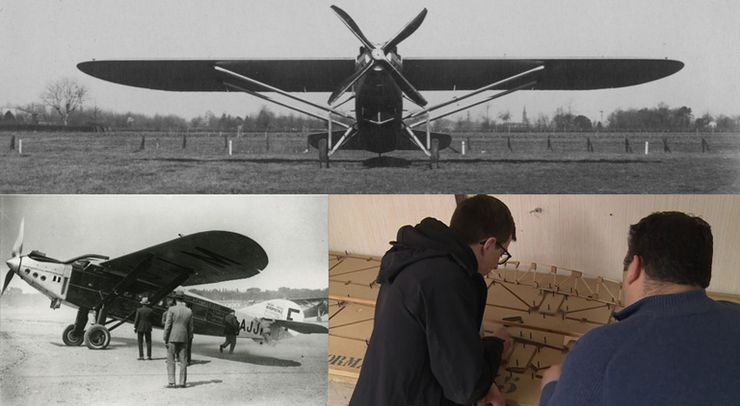
A set of students enrolled at UTC, have been investing time and efforts each semester for the past two years in a unique project: rebuilding a Latécoère 28, a French plane designed in 1929 of which no model exists today.
The Grand Palais Paris will host an exhibition, in 2018, to commemorate the centenary of air transportation. A Compiegne based association, the Cercle des Machines Volantes (CMV) will be associated with the event, deciding to rebuild a Latécoère 28, an emblematic French aircraft that left its mark on the early days of civil aviation. Frédérick Collinot, President of the Cercle, invited UTC to contribute to the aeronautical engineering aspects of the project. Indeed this is not the first collaborative work between UTC and CMV – UTC students have been engaged for 4 years now, rebuilding a Caudron C430 (the project is progressing smoothly but has been put on standby status for a while, as of 2016, the teams concentrating on rebuilding the Latécoère, deemed more urgent).
A project on this scale calls for rigorous organization and for this reasons, every semester, 4 to 5 students enrol for a project management credit course (CC). “We liaise with Mr Picard who initiated this project at UTC and the other students engaged in CCs as needed to implement the rebuild project and it is our remit to recruit the students”, explains Warren Pasini, himself a UTC student. “We also look after the sponsorship arrangements”.
Each CC there is an assignment of a specific problem that relates to the Latécoère rebuild programme. “Noteworthy CCs are ‘digital modelling’, to study the aircraft profile, propulsion unit ‘engine modelling’, another for the “wood stiffeners” and n for instance, this semester, we have a group studying canvas aerofoil skin properties”, explains Warren. But, prior to even envisaging rebuilding this aircraft, a huge amount of documentary research had to be done, notably for the technical, drawing held at the Latécoère Foundation and also by members alive today of the Latécoère family. “The students used the drawing as the base to begin their modelling work, and that allowed us to make pricing estimates for parts that we could not make directly in the CMV workshops”. The objective of the Association is to have all the parts needed made by early 2018 which then will be assembled in to the final aircraft structure ready for the exhibition at the Grand Palais in Paris. The air-engines and other function-related equipment will be fitted later, opening the prospect of a historic re-enactment of the very first aero postal flight between Europe and South America.
This unusual project attracted numerous students, lecturers and research scientists. “Those who join the project are not necessarily aeronautical fans when they start, but they become fans! Several students have decided to specialize in this field and one lecturer even gained his pilot‘s license”, notes Warren enthusiastically. It is a project that is highly enriching for the students inasmuch as they have a chance to directly apply their class-learned theoretical skills to a concrete case. It also requires them to display a large degree of self-motivation, of organization, of compliance with delivery dates and relevant distribution of the tasks to be carried out. “It is also a project that calls for a large personal commitment, amounting on average to 60 hours per semester. There is a huge level of responsibility attached to the project, given that the ultimate aim is that this rebuilt Latécoère will (and must) fly”, concludes Warren.
Rendezvous in 2018 at the Grand Palais, Paris!
Box
Pierre-Georges Latécoère created the Société Générale des Lignes Latécoère in 1918 (later to be known as the legendary Aéropostale, in 1927). WW1 had just ended. Military aircraft were being replaced by civil transport models and “By Air” postal services took a giant leap forward. Aircraft designers – to carry airmail and passengers over ever increasing distances – began proposing new models on a regular basis. This was indeed the case for the Latécoère 28, designed in 1929, with a passenger capacity of 8, in addition to the airmail load. In 1930, pilot Jean Mermoz made the first non-stop crossing of the South Atlantic aboard a float equipped Latécoère – it took him 21 hours in flight between Senegal and Brazil and this achievement opened the way for numerous aero postal lines from Europe to the South American continent.