Monitoring PFAS (per- and polyfluoroalkyl substances), Combining analytical innovation and public policy
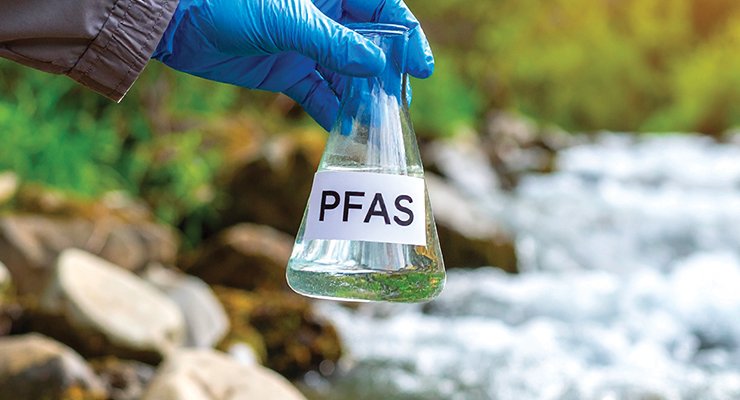
Respectively a lecturer-cum-research scientist specialist in urban planning in the Department of Urban Engineering at the URC-Avenues Lab and a research engineer at the Enzymatic and Cellular Engineering Laboratory (UTC-GEC), Selma Baati, who works on urban water management practices and Franck Merlier, who specialises in high-resolution mass spectrometry, led the project on PFAS monitoring, which was selected during the first call for proposals for TWIN 2026.
A project entitled ‘Monitoring PFAS: combining analytical innovation and public policy”, forms part of three CRIs as it addresses issues relating to resource management – in this specific case, water – the use of AI and, finally, the decarbonisation of Society.
How did the project come about? “Initially, before the CRIs were established, Carine Henriot, Nassima Voyneau and Nathalie Molines from Avenues, Rachid Djellali from the BMBI and I envisaged submitting, as part of a call for projects from the ‘Foundation for Medical Research’, the ExpoPFAs project, which aimed to better understand exposure to these contaminants in the Creil-Montataire industrial area and their potential health effects. This was a highly interdisciplinary project, as it involved UTC-GEC for analytical chemistry, UTC-BMBI for biological modelling and, finally, UTC-Avenues for geography and social vulnerabilities. The arrival of Selma Baati enabled us to broaden the scope of the issue and successfully submit the proposal in response to the first call for proposals,’ explains Franck Merlier.
A welcome addition to the team, bringing fresh expertise. “Indeed, I have been interested for some time in information infrastructures – that is, all the systems used to generate information on the management of water and sanitation services. The aim is that the use of this data can help to transform urban water management practices and, more generally, change our relationship with the environment,” emphasises Selma Baati.
Two PhD theses have thus been launched as part of TWIN 2026. The first, supervised by Franck Merlier, is devoted to the ‘development of AI agents for analytical prediction and the automated identification of emerging contaminants using LC-HRMS or liquid chromatography coupled with high-resolution mass spectrometry’; the second, supervised by Selma Baati, is entitled ‘Production and uses of environmental and health data in the context of regional governance. The case of the Oise catchment area’.
Monitoring PFAS, which are regularly detected in water resources in the Hauts-de-France region, is of prime importance. “This monitoring is not straightforward because there is a disconnection between the complexity of this family of persistent contaminants—which transform in the environment—and what current methods are capable of detecting and tracking. This raises, first and foremost, a question of knowledge: what are we actually capable of characterising?” adds Selma Baati.
Currently, regulations require the monitoring of only 24 PFAS. There are, however, thousands. A recent study has, for example, shown that, out of a sample of eggs analysed across the region, 60 per cent were contaminated with PFAS.
“One of the project’s initial objectives is to assess what high-resolution mass spectrometry can offer in terms of PFAS detection. We are particularly interested in two families of pollutants that are very prevalent in the Hauts-de-France region: the polar metabolites polar pesticide metabolites, linked in particular to chloridazone breakdown products, such as desphenyl chloridazone – the toxicity of which remains poorly understood – as well as per- and polyfluoroalkyl substances (PFAS), often referred to as ‘forever chemicals’. With this PhD research, we will broaden the scope of our investigation to include molecules other than those defined by regulations – molecules that we will classify using AI. This will enable us to speed up processing times and increase the number of PFAS identified with certainty,” says Franck Merlier. Indeed, when it comes to the risk of contamination, water is a key public health issue.
“It also plays a part in the circulation of these substances within the environment. Our initial premise was that, to improve the monitoring of these contaminants, it was not sufficient simply to improve detection methods. This also raises a second question: what becomes of the knowledge and new data generated on PFAS? How can they be integrated into existing monitoring systems? The PhD thesis linked to UTC-Avenues focuses on the practical monitoring of PFAS. It will involve tracking the data’s journey: how are they produced, using which tools, and how frequently? How are they validated and processed, and how do they circulate between the various stakeholders – analytical laboratories, local authorities, water operators, etc.? We will then examine how the data is utilised by these stakeholders to inform decision-making. Our aim is to understand the entire socio-technical system involved in the environmental and health monitoring of PFAS, in order to analyse the conditions within which we shall need to integrate analytical innovations,” concludes Selma Baati.
MSD