Facing contemporary crises: asking the right questions
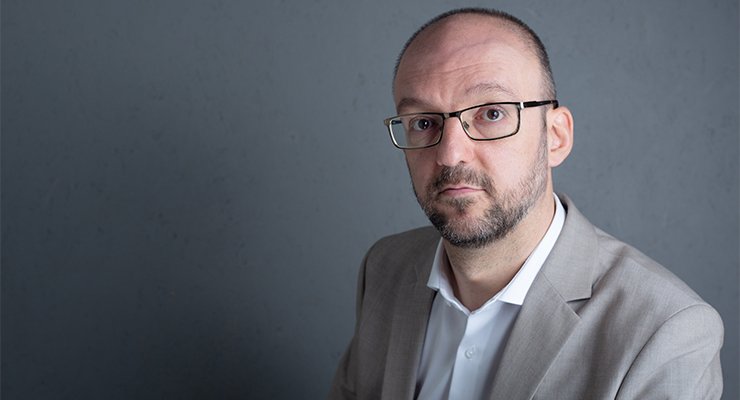
Guillaume Carnino, a senior lecturer in the history of science and technology, has been Director of the TSH department since Autumn 2025.
A department established in 1987 that has continued to evolve ever since. It is currently organised around three key principles regarding the teaching curriculum. The first concerns the ‘design’ modules, the second the ‘organisation and management’ modules, and finally, the third, the ‘communication’ modules. “The aim of these priority modules is to encourage students not to limit themselves to a single field and to enable them to deepen their knowledge in these areas. This is particularly important as students are required to choose two TSH modules out of the six available each semester. These are not academic disciplines in the strict, classical sense of the word, for example. If we take ‘design’ as an example, we can approach it from the perspective of epistemology as well as through design itself. In terms of management, students can focus on either human resources management or economics and, finally, in the field of communication, they can choose from languages, information sciences or public speaking skills”, he explains.
The UTC-TSH Department is yet again called upon to reinvent itself in the face of the upheaval caused by the advent and rise of AI, particularly generative AI. “The pervasiveness of AI is forcing us to innovate, particularly in our teaching methods. Until now, the great historical tradition of the humanities has been to produce written work not only in class but also at home. We operated on the principle that writing whilst thinking for oneself is how one learns to think. However, generative AI short-circuits this learning process and, as numerous studies show, jeopardises the very learning of autonomy and critical thinking,” says Guillaume Carnino.
Which subjects are most popular amongst students at TSH? “At UTC, we have quite diverse student profiles – sociologically, culturally and economically – and this is reflected in the choice of modules, with students adopting different strategies. At UTC-TSH, we believe it is very important for engineers to adopt a humanities-based approach to understanding – and, why not, solving – a number of today’s problems. Of course, there are always those who view the humanities from a purely utilitarian perspective. To caricature matters slightly, these people will be interested only in languages and management – which, in their eyes, are the keys to a successful career in the business world. But a significant proportion of the student body is increasingly aware of the environmental and social challenges facing the contemporary world,’ he asserts.
Himself a graduate of UTC, Guillaume Carnino turned to history very early on. Among the reasons? “I began studying science, naively thinking that it would help me understand the world. However, it didn’t teach me much about the world I was living in. But it was with hindsight that I discovered that, to understand the world, approaching scientific and technology related issues through the humanities proved to be extremely useful. At UTC-TSH, we believe that many of the problems facing humanity today are framed. very poorly This is the case with the energy transition, for example and the stated goal of low-carbon energy. This issue is poorly framed because the history of energy shows that there has never been an ‘energy transition’ but only the addition of new energy sources throughout the industrial era. We consume more coal and wood today than in the 19th century, even though oil, gas and then nuclear power have been added to the mix. Hence the value of courses that scrutinise this trajectory and enable us to reflect on this issue in a different light. The approach favoured at UTC-TSH – and what we aim to teach our students, is how to ask the right questions’, he concludes.
MSD