ÉCOTRAIN, a successful venture
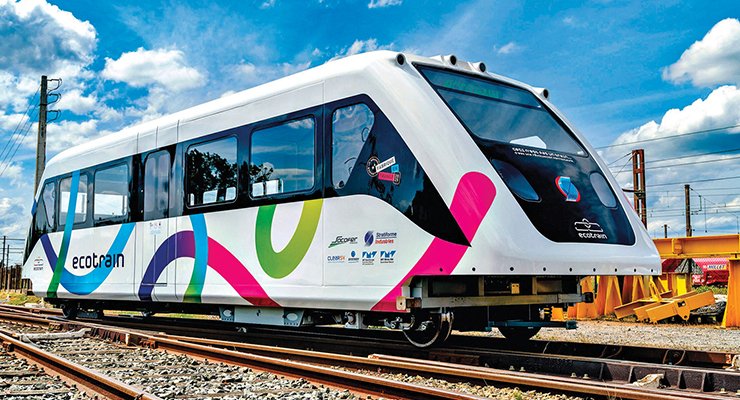
Professor emeritus Walter Schön and Mohamed Sallak, a tenured university professor at UTC, are both specialists in operational safety at UTC-Heudiasyc. They worked on the éCOTRAIN project, a project led by Philippe Bourguignon, a member of the IMT Albi-Carmaux Scientific Council until 2022. In 2025, they were joined by Joëlle Al Hage, a senior lecturer at UTC-Compiegne.
The project is funded by France 2030 and operated by Ademe, involving four industrial partners, Stratiforme Industries, Socofer, Clearsy and Syntony, and, in addition to UTC-Compiegne, an academic partner, IMT Albi-Carmaux. This project was launched in 2023 for a duration of four years, and an initial prototype was first tested on a 10-kilometre stretch in the Albi region from 2025. The trial proved successful, as the shuttle was presented at the Élysée Palace in November 2025 as part of the ‘Fabrique française’ initiative. This project is of immense environmental and social significance.
Indeed, many local rail lines have been closed due to a lack of profitability, resulting in the certain areas becoming isolated; and, in those where such lines remain, they represent not only a significant economic cost but also an environmental one, as 42 % of trains run on diesel. The aim of the ÉCOTRAIN project was to develop electric, battery-powered, autonomous, i.e., driverless, shuttles, which, crucially, require no maintenance of ground-based signalling systems and can travel an average of 70 km. “Conventional trains are guided by track-side signalling, namely by beacons located on either side of the track, which requires costly maintenance. In contrast, the small ÉCOTRAIN shuttles are guided by satellite (GNSS). Approximately 16 metres long and weighing between 10 and 12 tonnes – compared with the 50 tonnes of a conventional TER – they will have 32 seats. Automated operation will thus ensure a high frequency of service – we are aiming for services every half-hour – with timetables tailored to schoolchildren and workers, a ‘stop-on-demand’ system… These shuttles, by opening up previously isolated areas, could also revitalise them both economically and demographically. Furthermore, their lightweight construction and the options being considered for track design – notably the use of next-generation rails – will ultimately enable a drastic reduction in implementation and operating costs, whilst natively incorporating the issue of their “recyclability”, explains Mohamed Sallak.
What is the UTC’s specific role? “We were not involved in setting up the project, but we have been invited members since its launch in 2023. Operational safety and security constraints are of paramount importance when transporting passengers. Recognised for our expertise in these fields, we are conducting research on this project – primarily in collaboration with Syntony – into the operational safety assessment of satellite positioning (GNSS) to guarantee the accuracy and integrity of the shuttle’s position using relevant metrics. We have also integrated sensors such as lidars, for example, to ensure continuous positioning – when the train is in a tunnel, for instance – but also to improve obstacle detection. This has proved a success, as in April 2026 a prototype was successfully tested at Saint-Pierre-des-Corps, a town in the Indre-et-Loire Department, in the Centre-Val de Loire Region of France.
It is located immediately east of Tours and is best known for Saint-Pierre-des-Corps railway station, a major TGV hub serving the Tours area, where all rail-related trials are carried out. Don’t they say that the most reliable train is the one that’s standing still? Indeed, the rail sector is one where striking a balance between safety and availability is a major challenge. The former requires that all necessary safeguards be validated. The latter can only be ensured through the robustness of the former. Safe and reliable trains: this is what was demonstrated during the tests. Today, the pre-commercialisation phase of the ÉCOTRAIN has been launched with the aim of starting to run shuttle services, at speeds of 70–100 km/h, by 2030”, he explains.
To carry out the pre-commercialisation phase, a company called ÉCOTRAIN, chaired by Philippe Bourguignon, has been founded. “The funding requirements are by no means insignificant. At present, the company is seeking funding from local authorities, particularly those facing isolation or the risk of line closures due to low profitability. But this is a product that should also attract international interest. If orders are received in sufficient volume, the industrialisation phase should commence”, he explains.
This project does not stop there, as the partners are currently working on a freight equivalent based on a shared technical platform. “The aim will be to develop lighter shuttles, weighing around 5 tonnes, for micro-freight – that is, the transport of goods over the last few delivery kilometres,” concludes Mohamed Sallak.
MSD