DASVIDANIA — AI for an autonomous acoustic drone
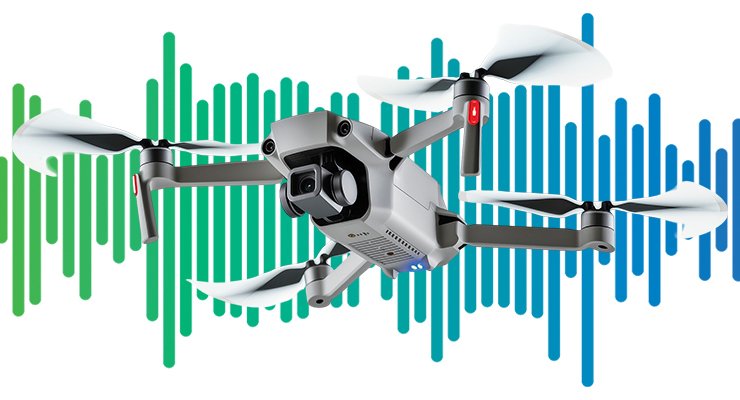
Jean-Daniel Chazot, a tenured professor in the Department of Mechanical Engineering at the UTC’s Roberval Laboratory and a contract lecturer attached to UTC-Heudiasyc together with Jean-Daniel Chazot, a member of the resident « Acoustics and Vibrations » team and Jossué Cariño Escobar, a robotics engineer working on aerial drones, led the DASVIDANIA project, which was selected during the first call for proposals under the TWIN 2020 programme.
‘An initial collaboration with Pedro Castillo of Heudiasyc and Sorbonne University, as part of a Cifre PhD funded by CETIM, has brought the fields of acoustic imaging and drone control closer together. This has resulted in the development of an autonomous drone demonstrator capable of iteratively detecting acoustic sources, from the loudest to the faintest,” explains Jean-Daniel Chazot.
A successful experiment, carried out by a single PhD student, which both teams wished to continue. The call for proposals for TWIN 2026 programme therefore came at just the right time, and DASVIDANIA (Acoustic Drone for Autonomous Surveillance and Detection Powered by Artificial Intelligence), as part of the CRI ‘Artificial Intelligence and Technological Systems’, was proposed to combine expertise in acoustic imaging with that in drone control in order to improve the performance of the current drone.
Two PhD theses have been launched; one, supervised by Alessandro Victorino and co-supervised by Jossué Cariño Escobar, focuses on developing a robust adaptive control system for a drone using an AI-based disturbance compensation approach; the second, co-supervised by Jean-Daniel Chazot and Gautier Lefebvre from UTC-Compiegne, as well as by François Ollivier from the Sorbonne University, is dedicated to optimising a drone-mounted microphone array aimed at tracking an acoustic target and to “noise cancelling” acoustic measurements in the presence of airflow.
“One of our objectives is to develop an autonomous drone equipped with an acoustic array and to integrate AI into it in a specific way. At UTC-Heudiasyc, we had already begun using neural networks for drone control, but we wanted to go further and integrate other AI methods, not only for the acoustic sensors but also for the control system. The idea is to design a robust adaptive controller fed in part by acoustic data. Thus, knowledge of wind direction, velocity or strength will enable us to improve control efficiency and ensure greater stability for the drone,” says Jossué Cariño Escobar.
What role does AI play in optimising the acoustic antenna? “From an acoustic perspective, we want to take things further. Currently, the demonstrator is in an indoor flight chamber; the aim with DASVIDANIA is to develop a drone capable of flying outdoors, where it will be subjected, in particular, to wind noise that will degrade its acoustic performance. Not only the wind, but also air turbulence caused by the drone itself will disrupt the noise we wish to measure and potentially drown out the signal to be detected. The ’The idea is to detect wind noise – its direction and intensity – and then substract this noise from the measured signal. Until now, we have relied on conventional noise-cancelling techniques. In this project, we have decided to incorporate AI trained using experimental data collected in an anechoic chamber. ‘This will enable us, in a second phase, to substract wind noise from in-flight acoustic measurements,’ explains Jean-Daniel Chazot.
This work is being carried out in collaboration with the Sorbonne University. “They have extensive expertise in acoustic measurement antennas. In particular, they have developed the antenna system based on ultra-lightweight MEMS microphones that we will be using in this project,” adds Jean ‑Daniel Chazot.
DASVIDANIA is of great importance for improving the drone’s performance in terms of detecting, locating and tracking an acoustic source. What are some potential applications? “There are many, and they can address both civilian and military challenges. The acoustic drone could, for example, be used to detect a gas leak in industrial networks or to locate people in distress,” says Jossué Cariño Escobar.
Jean-Daniel Chazot adds: “The drone could also tackle the worrying issue of intrusive drones flying over sensitive sites such as airports or nuclear power plants or even detect and eliminate invasive alien insects such as the Asian hornet.”
MSD