AMPIRE — Developing a smart prosthesis to promote independence
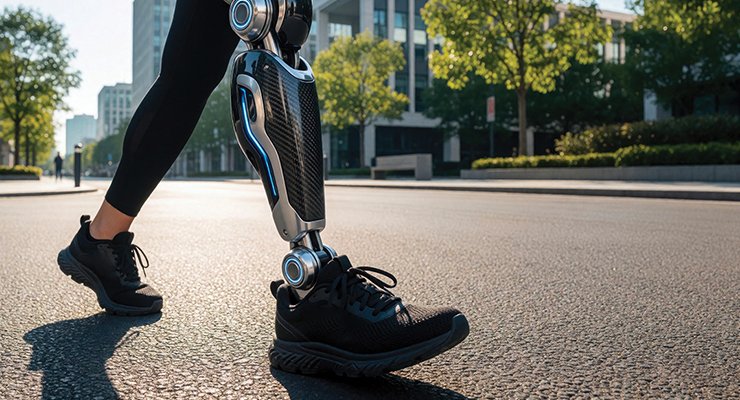
How can we improve the comfort, reliability and everyday usability of lower-limb prosthetic devices? Led by Khalil Ben Mansour, head of the BioMovE research area at the UITC-BMBI laboratory, and Malek Habak, a lecturer-cum-research scientist at the Roberval laboratory, the interdisciplinary AMPIRE project combines biomechanics and materials engineering to better understand prosthetic walking and pave the way for smart prosthetic devices tailored to each patient’s needs. Selected as part of the ‘Living Well and Ageing Well’ CRI, it is based on a collaboration with the Le Belloy functional rehabilitation clinic.
Starting with patients’ needs
The origins of AMPIRE (Instrumented Prosthetic Gait Analysis for Rehabilitation), was a real-world encounter. “A week before the call for proposals, Malek and I had visited a specialist rehabilitation centre. The centre wanted to benefit from our expertise in motion analysis. When we came across the theme ‘Living Well and Ageing Well’, we immediately thought of the challenges of mobility and independence faced by people with amputations,” explains Khalil Ben Mansour.
This line of thinking echoes the personal experience of Malek Habak, who spent several months in a rehabilitation centre following an accident. There, he interacted with amputees and observed the difficulties associated with wearing their prosthetic devices, particularly chafing, discomfort and the regular adjustments required for the devices. “This experience gave me a better understanding of the challenges patients face on a daily basis and strengthened our determination to develop an approach that links the mechanical functioning of the device to the wearer’s comfort,” he emphasises.
Regaining functional mobility is not simply a matter of having such a device. Asymmetrical weight-bearing, compensatory movements, instability and increased energy expenditure can complicate movement, particularly during everyday activities. The challenge is therefore to gain a better understanding of these difficulties in order to promote more fluid, comfortable and independent mobility.
Two PhD theses, a shared ambition
To address this challenge, AMPIRE brings together the complementary expertise of the UTC-BMBI and UTC-Roberval laboratories via two PhD theses, designed as two parts of a single project.
Within the BMBI Lab, the research led by Khalil Ben Mansour focuses on the functional analysis of walking. “We want to understand how an amputee adapts to their device, looking beyond mere criteria of speed or symmetry. We are seeking to identify biomarkers of movement fluidity that can characterise the quality of walking, including real-life situations: turning, climbing stairs or getting into a car.” This research will notably utilise wearable inertial sensors and non-linear analysis methods. It will enable the development of a composite score incorporating fluidity, stability, energy expenditure and mental load, followed by the creation of personalised simulations to optimise the interaction between the deviced and the patient’s motor strategy.
At the Roberval Laboratory, Malek Habak is working on the design of an instrumented device or socket-mounted device. The aim is to integrate sensors capable of measuring parameters such as deformations, temperature and pressure, in order to better characterise the mechanical stresses and interactions between the body and the device. “We want to develop a prototype self-instrumented composite device that provides information on its behaviour under real-world conditions. This data could help to improve its design, reliability and comfort of use,” he explains.
The originality of AMPIRE lies in the combination of these two approaches. Biomechanical analyses will help identify the relevant indicators to be measured within the device. In turn, the data from the sensors will help refine gait models and guide the design of the device as well as the positioning of the sensors.
“At present, in-depth study of gait kinetics often relies on specialised equipment that is costly and difficult to access outside dedicated facilities. Our aim is to develop tools that will, in the long term, enable us to better assess gait using data collected directly by the instrumented device,” explains Malek Habak. This approach could thus facilitate patient monitoring outside the laboratory and bring scientific assessment closer to real-life conditions.
From proof of concept to the smart prosthetic device
In the short term, the project aims to validate biomarkers of fluidity, build a database and produce a prototype of an instrumented prosthesis. In the longer term, the knowledge gained could contribute to the development of a personalised digital twin, followed by smart prostheses incorporating on-board sensors and, ultimately, feedback tailored to the patient.
For Khalil Ben Mansour and Malek Habak, the challenge therefore goes beyond mere technological performance: the aim is to link the mechanical properties of the device to the functional experience of the amputee. Advanced discussions are currently underway with several functional rehabilitation centres with a view to establishing long-term collaborations and preparing for future validation stages.
With AMPIRE, both the BMBI and Roberval teams aim to bring biomechanics and materials science together to open up new prospects in terms of personalised prosthetics, comfort and independence for amputees.
MSD