Techno-flavours: the science behind our taste buds
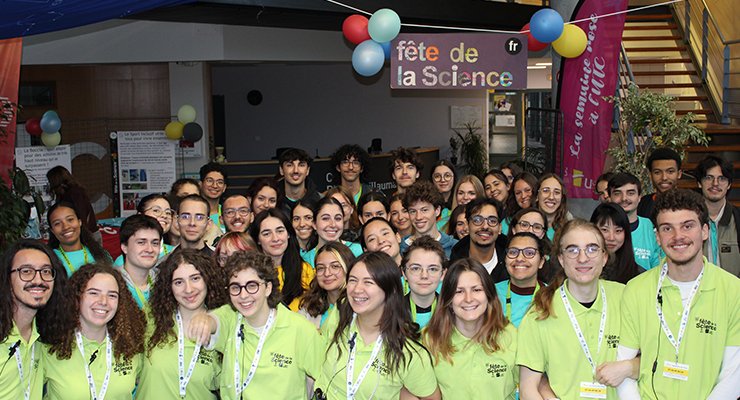
UTC-Compiegne and ESCOM organised the Science Village for the 35th edition of the Science Festival, which took place from October 8–11. This free event, open to all, featured stalls, workshops, exhibitions and a series of talks dedicated this year to food, exploring the links between science, taste, cooking and health.
More than 40 workshops and lectures were on the programme for the 2026 Fête de la Science, spread over more than 3 000 m2 at UTC. Among the talks in the Science Village was one entitled ‘The other side of our plates: true stories that will surprise you’, given by Karim El Kirat, a member of the UTC’s BMBI laboratory and head of organisation for the Science Festival within the university’s Scientific, Technical and Industrial Cultures (CSTI) division. ‘“There is, in fact, a whole team behind this, comprising students handling logistics and organisation, project manager Aurélie Salin, and Sylviane Héau, who plays an active and enthusiastic role on the organising committee for the UTC Science Festival. All of UTC’s departments and laboratories are also pulling together to ensure this event remains a celebration”, explains Karim El Kirat. Another talk, held on Saturday, October 10 and Sunday 11 and entitled “From peelings to biogas: the magic of anaerobic digestion”, was presented by Xiaojun Liu, Thierry Ribeiro and Sorosh Samiei from UTC’s TIMR laboratory (process engineering). They demonstrated how vegetable peelings can be turned into green energy. Through anaerobic digestion, microorganisms produce biogas and a natural fertiliser. Their ‘Interreg FWVL OBIWAN’ project, which brings together UTC-Compiegne, the CNRS in Lille, Certech (Belgium) and Ghent University (Belgium), aims to transform this organic waste into biofuels (biomethanol). UTC Director ¨Professor Claire Rossi has also imagined and implemented the workshop ‘Combining pleasure and health taking fibre!’ to explore the secrets of dietary fibre, its health and digestive benefits, and baking tips to try at home.
Nursery school pupils and interactive experiments
“This year, for the very first time, we organised a Science Festival specifically for nursery school children (middle and senior nursery classes) on Monday October12, featuring workshops on magnets, Scratch, electricity, buoyancy, insects… We welcomed 293 children from the Compiègne area, divided into 21 groups. They got hands-on with fun experiments which, we hope, will spark their interest in science,” adds Karim El Kirat. Among the workshops on offer at this 35th edition was one led by Audrey Drelich from the UTC-TIMR Laboratory, entitled “Manufacturing secrets and scientific recipes in your bathroom”, and ‘When drones feed the future’, led by Sergio Urzua Correa from the UTC-Heudiasyc Laboratory, on how drones will help feed the world tomorrow and how aerial technologies will contribute to ‘smarter’ forms of agriculture. Members of the Biocodex laboratory came to talk about the ‘scientific flavours’… of medicine, opening the doors to pharmaceutical research through a series of interactive experiments. Mohammed Benali from ESCOM enabled young and old alike to discover, through simple experiments, how science reveals the tastes, colours, smells and benefits of natural ingredients such as propolis, rosemary and coffee.
Bird beaks and Smurf foam
Timothée Baudequin, from the BMBI laboratory at UTC and a member of the Oise Bird Protection League, came to talk about what birds eat. “Fruit, insects, seeds, meat or even fish – birds eat everything… but not with the same beak!” Thanh Loan Nguyen, from ESCOM, came up with the idea of taking real jelly Smurfs and melting them in the microwave with lemon juice to create a super-viscous blue potion. By mixing this potion with bicarbonate of soda, the viscous liquid disappears as if by magic, giving way to a mountain of foam as soft and light as a cloud. The The Atomes Crochus association, for its part, offered experiments insp9ired by the world around us, our everyday environment, our kitchens… but also by questions we might sometimes ask ourselves, such as: can you cook an egg without heat? Can you light a candle without a flame touching the wick? Lucas Lardot from the waste management department of the ARC (Compiègne Regional Authority) led a wonderful awareness-raising session on composting organic waste. “Composting is about turning your kitchen and garden waste into a fantastic natural ‘fertiliser’. Fruit and vegetable peelings, fallen leaves… All of this becomes a useful resource instead of ending up in the bin! The result: less waste, richer soil, healthy plants and a small but concrete step for our planet.”
KD