“Our destiny lies with: Sorbonne universities”
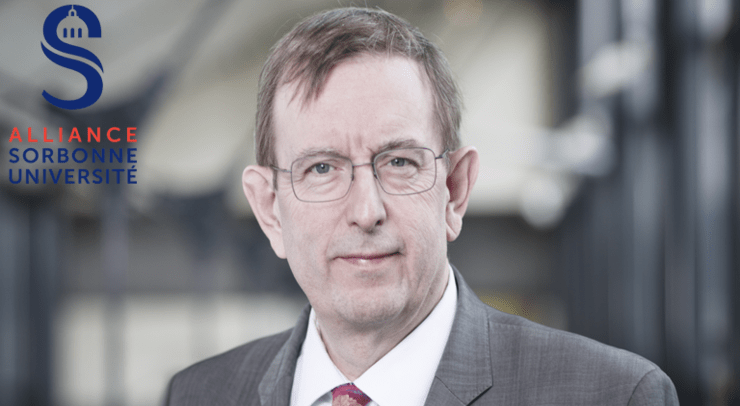
Appointed Director of UTC, the University of Technology, Compiegne, in 2017, Dr Philippe Courtier truly seeks to see his institution progress in the framework of the HE cluster Sorbonne Universities (SU) and to widen the vista and scope of UTC students to the possibilities of the world of high-class research. To bolster this vision, the class return 2018–19 will see a series of Inaugural Lessons taking place on campus.
a village called Melle, in the Deux-Sèvres department when, as the saying goes, Philippe Courtier was only knee-high to a grasshopper, he succumbed to the charms of science and technology. His Grand-Father as a creative and impassioned chemist. “He even gained his PhD without first getting his Baccalaureate and, indeed, was the first scientist in the family” and Philippe adding that, with him, he had been proud to learn the art of blowing glass recipients, etc., used in his Grand Dad’s laboratory. At the age of 12 he helped his engineer Father, with oily hands-on, to repair the family car engine, after a crankshaft failure. Aged 13, he was into “special relativity”, thanks to a book by George Gamow and that started him delving into and devouring all the books in the family library on this subject. Hence our surprise to hear him say how bored he had been at his Lycée Joseph Desfontaines, in Melle. However, the state of boredom was not to last long.
He was admitted to the class of 78 and graduated from Ecole polytechnique; he chose the École nationale de la météorologie as his “école d’appli” because of his “acquired taste and propensity for science”. It was at ENM in the course of his end-of-studies laboratory internship that he discovered the meaning and purpose of doing research. Consequently, he decided to do a PhD and he presented a thesis on application of optimal control theory to weather forecasting (at Méteo-France, viz., the national weather centre and at the LMD (laboratory for dynamic meteorology studies-CNRS. His research was done with “computers not exceeding 128 kilobytes memory” but nonetheless allowed him to use his observations for weather forecasting and opened the door to the ECMWF (European Centre for Medium-Range Weather Forecasts (Reading, UK). “It is the premier centre of its kind in the world, five years ahead of the USA in this particular field” , he explains. Philippe Courtier has authored numerous scientific papers, receiving a prize award from the French Academy of Science and one from the Royal Meteorological Society, and his career accelerated in grand manner thereafter.
After a term of work with the CNES (France’s national space agency) followed by time at the Laboratory for Dynamic and Climate-related Oceanography, in 1999 he was appointed, Deputy Director General for Méteo-France at the age of 41. He stayed with Méteo-France for 5 years and chaired the scientific committee of the World Weather Research Programme (WWRP), 2002 ‑2005. It was as of this point that his career shifted its heading, from research scientist institutional senior management positions.
Director* of UTC
/*equivalent to President & Vice-Chancellor for an Anglo-Saxon establishment. In 2017 at the age of 59, Philippe Courtier was appointed to the position of Director of UTC, a university which trains some 4 000 student engineers and 300 PhD students each year. Question — What are your vision and project for UTC within the HE cluster Sorbonne Universities? PC- “It is UTC that carries the project, not me. The role of the Director and his team of colleagues is to serve the institution and to ensure it progresses”. The two key advantages for the engineering school, as he sees them, are primo that, although UTC is ‘young’, it enjoys a strong reputation for potential candidates’ families. The Director underscores the fact that 90% of the students admitted earned a “Très Bien” ranking (³16/20) in the Baccalaureate. “In the space of 40 years, UTC has become a key player in Higher Education in France”; secondo, the UTC staff are all highly committee to their establishment. This is why Philippe Courtier refuses the notion of “his project” and prefers “the institutional project carried by the entire UTC community”.
There is, however, one weak point in UTC, according to Phillipe Courtier, its size, both in terms of undergraduate student engineers and PhD student populations. “Other technology-intensive universities in Europe are at least twice as big”’, he says. “Certainly, our objective cannot be just to grow for growing’s sake, but we should aim at covering a wider range of engineering fields, to be comparable to other European universities”.
Question – what might his growth ambition be? Philippe Courtier sees this taking place in specialties where currently UTC is not too present – “water, energy, environment, industrial engineering and digital systems”.
and in terms of greater European and world-scale ‘visibility’? He see this happening within the framework of the Sorbonne Universities HE cluster. “Our destiny lies with Sorbonne Universities”, Dr Courtier forcibly repeats the credo. … and why believe in this?
The first reason is the undoubted world image of the Sorbonne itself. Then second reason is tied to the size of “the University of Paris 6 (Pierre & Marie Curie) with its Faculty of Science and Engineering and its Faculty of Medicine, making it the largest science-oriented university in Europe and in the “top 100” in the world-class rating”, details Philippe Courtier. Hence his desire to contribute to “the development, of the technology-intensive pole of Sorbonne Universities, the excellence of which was confirmed in 2018 by an international jury of experts”.
The Inaugural Lessons
n launching the series of Inaugural Lessons, as of year back 2018–19, UTC has the intention to create “a first positive encounter between students and science, between students and high level research”. The first lecture will be delivered by François Forget on the theme ‘Exploring the Solar system to understand the Earth better’; the second lecture will be: “Common and digital assets”, by Benjamin Coriat, economist; and, last but not least, in this initial series of 3 lectures “A Primer in Automatic Learning Processes will be given by Thierry Denoeux, UTC-GI computer science departmental professor and research scientist at the UTC-Heudiasyc Lab.