A common charter, symbolizing the unity and shared values of the UT group
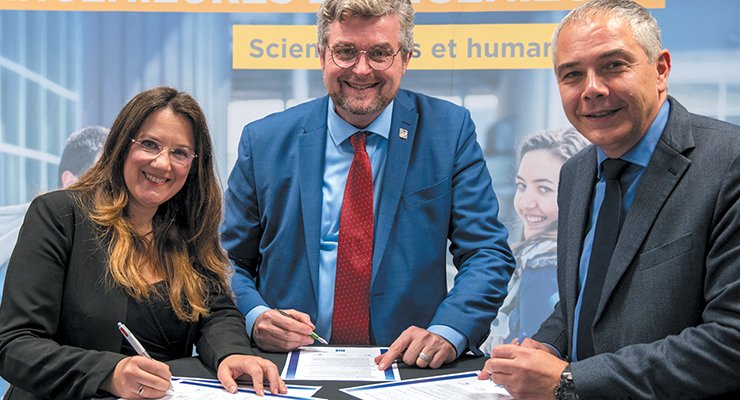
Prof. Claire Rossi, Director of UTC, Prof. Christophe Collet, Director of UTT-Troyes and Prof. Ghislain Montavon, Director of UTBM (Belfort-Montbeliard), jointly presented the UT Group’s basic identity values at a press conference held in Paris in December 2024 and co-signed a common charter to this end.
On December 10, 2025 Claire Rossi (UTC), Christophe Collet (UTT-Troyes) and Ghislain Montavon (UTBMBelfort- Montbeliard), the three directors of the Universities of technology (UT), signed the UT Group charter. This marks an important step in strengthening collaboration between Groupe UT members. “Our universities, embodying the “third way” of higher education, have positioned themselves, since 1972 with the birth of the first UT (viz. UTC) as catalysts of innovation, training in engineering and research, a community carrying humanist values”, emphasizes Claire Rossi, President & Vice- Chancellor of UTC. The group of universities of technology is positioned as a dynamic community of education, research and innovation, uniting the strengths of these establishments to meet current and future challenges in an ethical and responsible manner. Exchanges within the UT Group are proving to be very positive, driven by a strengthened collaborative dynamic. The teams at the various UTs are increasingly involved in a dynamic process, sharing as they do common objectives, demonstrating a real synergy. “My two counterparts, Claire Rossi and Ghislain Montavon and I are unanimous: together we are stronger than if acting apart. In an uncertain context, this unity enables us to speak with a more powerful and coherent voice, notably through coordinated and structured communication,” assures Christophe Collet. The UT group enables us to change scale by bringing together a larger number of students, PhD doctoral students and alumni, while developing an even wider network of partnerships with companies.”
A unique and valuable synergy in the academic landscape
This consortium makes it possible to carry out large-scale projects that would not be feasible on a single establishment basis. Cross-disciplinary research projects encourage innovation and collaboration between the various UTs. Internationally, initiatives such as UTSEUS and partnerships in Africa illustrate the group’s ability to engage in shared projects, contributing to a global academic and technological network. “This collaboration not only reinforces pedagogical excellence, but also the ability to respond to contemporary technological challenges, while training tomorrow’s engineers. UTBM stands out for its resolutely innovation-oriented positioning. In this respect, the integrated “CRUNCH” scheme, deployed since 2017, illustrates perfectly this ambition, promoting a cross-disciplinary and collaborative approach. UTBM has also invested in steering and decision-making tools. For almost a decade now, it has been developing sophisticated data warehouses and high-performance indicators to optimize internal management. These implementations are fully shared within the UT network,” adds Ghislain Montavon, who believes that belonging to this network of universities of technology enhances the visibility and reputation of each establishment. “Indeed, the ‘UT’ collective brand is a guarantee of quality and expertise, recognized both nationally and internationally. This recognition attracts the best talents in both students and professors and arouses the interest of leading industrial and institutional partners”.
A group committed to the dynamics of European universities and AI
UTT is committed to the dynamics of European universities, acting as AI coordinator of the EUT+ Alliance, the European University of Technology, and became involved in the dynamics of European universities at a very early stage. Today, European courses are already available to students, reinforcing the international scope of our courses. UTC has also become a member of the SUNRISE alliance of European universities since this year. Christophe Collet adds: “One of our current key areas of reflection also concerns the impact of AI (artificial intelligence) on engineering education and training. Through Groupe UT, we are working to train engineers in the thoughtful and ethical use of AI, to support teacher-researchers in integrating AI into their teaching methods, and to define the key skills needed to anticipate and respond to tomorrow’s technological challenges.” It’s worth remembering that the UT Group establishments carry out ambitious, first-rate research. It makes a significant, even disruptive, contribution to scientific and technological advances for ethical and responsible progress,” concludes Claire Rossi. We foster creativity in students and research scientists and engineers by stimulating transdisciplinary and intercultural approaches. But we do not neglect to cultivate the freedom to experimentation in order to encourage innovative, ambitious, even disruptive approaches, up to and including the launching entrepreneurship ventures.”
KD